Optimize Your SAM.gov & DSBS Profiles for AI Crawlers: Re-write capability narrative sections using precise, standardized federal SOW terminology, exact NAICS/PSC codes, and explicit technical skills so AI procurement filters capture your profile.
Accelerate Getting on a GSA MAS Schedule: If you do not currently hold a GSA Schedule contract, securing one and ensuring all your SBA socio-economic badges are correctly linked is mandatory to remain in the automated buying pool.
Audit Your SBA Certification Data: Ensure your SBA portal, CAGE code details, and SAM.gov representations match 100?ross all federal databases to prevent algorithmic disqualification during pre-award AI scans.
Target "Staff Augmentation & Automation" SOWs: Position your small business services directly as solutions that compensate for lost federal headcount such as workflow automation, outsourced administrative support, and managed IT services.
The intersection of AI-driven procurement tools on GSA Multiple Award Schedules (MAS) and a mass reduction in federal personnel (~330,000+ civ-servant cutbacks via restructuring) creates a fundamental structural shift in federal contracting.
For Small Business Administration (SBA) certification holders that include 8(a), HUBZone, WOSB, and SDVOSB firms, this double-edged transformation dismantles traditional relationship-driven government contracting while creating new marketing dynamics.
Historically, small business contractors relied heavily on building personal relationships with Contracting Officers (COs), Small Business Technical Advisors (SBTAs), and agency Program Managers.
Downsizing Impact: With fewer contracting officers and program managers and expanded workloads, federal buyers no longer have time for industry days, capability statement reviews, or meetings.
The AI Procurement Shift: Agencies are deploying AI sourcing tools across GSA eBuy and Advantage to parse market research, auto-generate RFQs, evaluate baseline compliance, and identify set-aside vendors automatically.
Impact on SBA Holders: If your company relies on personal networking rather than digital machine-readability, you will become invisible. AI procurement bots scour SAM.gov profiles, NAICS codes, capabilities statements, and GSA Schedule catalogs looking for matches to statement of work (SOW) keywords. Your SAM.gov data, past performance citations, and GSA catalog must be optimized for AI indexing/SEO, not human eyes.
With 330,000+ fewer federal workers, remaining agency procurement teams face an overwhelming administrative burden. Full and open standalone solicitations take 9 to 18 months to process a timeline undermanned agencies can no longer afford.
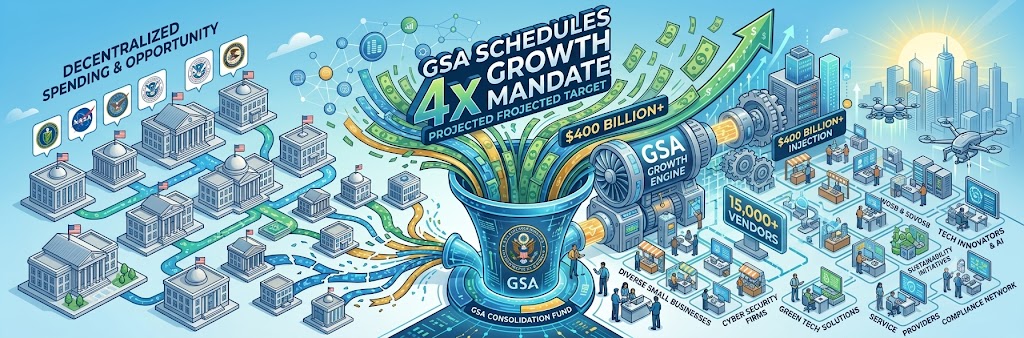
Heavy Reliance on GSA Schedules: Agencies will increasingly default to GSA MAS because pricing, labor categories, and FAR compliance are pre-negotiated.
Automated Small Business Set-Asides: GSA eBuy and automated AI procurement systems allow contracting officers to execute a set-aside order (e.g., 8(a) or SDVOSB set-aside) with a single click.
Impact on SBA Holders: Holding a GSA Schedule is moving from an "optional vehicle" to a strict prerequisite. Uncertified small businesses or those relying solely on open-market RFP boards (like SAM.gov opportunity feeds) will be bypassed entirely as automated buying leans heavily on GSA MAS and multi-award BPAs.
Understaffed agencies are using AI algorithms to conduct initial compliance screens on proposals before a human evaluator ever opens a file.
Lower Human Discretion: Previously, a friendly CO might give a small business a brief cure notice or clarification for a minor technical formatting flaw. AI screeners reject non-compliant bids instantly for missing past performance cage codes, misaligned labor category qualifications, or incorrect socio-economic representations.
Verification Pressure: SBA certification status (especially SDVOSB, WOSB, and HUBZone) is being cross-checked automatically against SAM.gov and SBA databases in real-time. Any discrepancy between your GSA schedule socio-economic indicators and your active SBA certification will result in immediate algorithmic disqualification.
As the federal workforce shrinks, agencies are shifting from managing hundreds of individual small contracts to awarding larger, consolidated task orders to prime contractors, while mandating automated small business subcontracting targets.
Subcontracting AI Matching: Large primes (e.g., Leidos, Booz Allen, CACI) are also adopting AI procurement systems to manage their mandatory SBA subcontracting plans.
Impact on SBA Holders: Small businesses that offer highly specialized, modular technical solutions (especially in IT modernization, automated workflow replacement, cyber defense, and AI integration) will see increased demand as primes search GSA schedules for fast, certified sub-tier partners to meet socio-economic quota requirements.

 IT Reality Check.jpeg)