Background
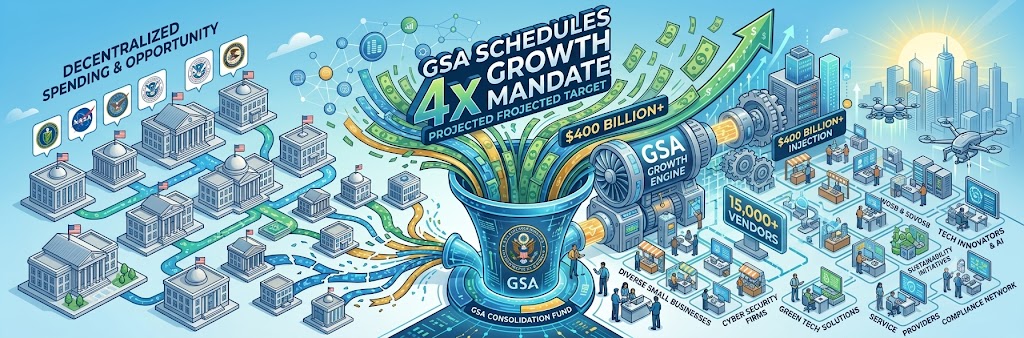
In March 2025 Executive Order 14240 Eliminating Waste and Saving Taxpayer Dollars by Consolidating Procurement was put into effect. This Executive Orders goal was to force approximately $400 billion in federal spending on the GSA Schedule System.
Reality
The GSA Schedule in 2025 had about $51B in federal sales and sales were essentially flatlined from 2024 so how is this 4x in sales going to occur? We will first look at the projections for the total sales for the current 14,400 GSA Schedule Vendors. Then we will go into the rational for those projections.
| Fiscal Year | Total MAS Sales | Status | Market Driver |
| 2024 | $51.5 Billion | Actual | Standard historical growth and pre-consolidation agency buying. |
| 2025 | $51.0 Billion | Actual | Slight contraction (~2.6%) due to budget uncertainty and initial "DOGE" (Department of Government Efficiency) federal spending cuts. |
| 2026 | $70B – $85B | Projected | The "Transition Year." Early shifts from decentralized agency buying to GSA centralization take effect. |
| 2027 | $120B – $160B+ | Projected | The "Surge Year." Fixed-price mandates and the 4x consolidation goals force massive volume through the Schedule. |
1. Agency Restructuring is Underway
There are actual, physical changes to agency procurement offices currently taking place. For example, early in the process, the Office of Personnel Management (OPM) essentially dissolved its internal procurement team to serve as a pilot program, shifting its purchasing power directly to the GSA. The Office of Management and Budget (OMB) has also been aggressively onboarding into the GSA's centralized system.
2. The Shift to "Fixed-Price" Contracts (April 2026)
Just last month, a massive new executive order was signed that makes "fixed-price" contracts the default method of federal procurement, severely limiting the use of "cost-reimbursement" contracts (which historically allowed contractors to bill for cost overruns).
3. Strict Data Sharing & Transparency Mandates (March 2026)
To stop agencies from acting in silos, the OMB issued a sweeping memorandum (M-26-10) requiring agency Chief Information Officers (CIOs) to actively share IT acquisition data, vendor pricing, and utilization rates across the government. Solicitations now require vendors to disclose this information without limits on how it is shared internally. The days of charging the Department of Energy one price and the Department of Homeland Security another are rapidly ending.
4. Shrinking the Vendor Pool
The government's GSA usage goal isn't necessarily to give every contractor four times as much work; rather, they are funneling four times the volume into a smaller, heavily vetted pool of vendors. The GSA has been busy "rationalizing" their contract vehicles cutting redundant categories, booting non-performing vendors, and adding incredibly strict new compliance clauses (like the new AI safeguarding requirements proposed in March 2026).
Change is Coming
The bureaucratic plumbing is largely in place. The rules have been changed to make buying outside of the GSA incredibly difficult and heavily scrutinized, which means that over the next 12 to 24 months, we are going to see a massive flood of volume formally transition onto the GSA Schedule.
We can evaluate if your business qualifies for a GSA Schedule in just 10 minutes. Give us a call today to see if you are positioned to capture this historic shift in federal spending.

 IT Reality Check.jpeg)