Current Federal Happenings
In early 2025 the current administration took various steps to reduce the federal civilian workforce which stood at roughly 2.4 million employees.
Through a rapid-fire combination of the Deferred Resignation Program (which paid employees to step down), the firing of probationary workers, and targeted Reductions in Force (RIFs), and removal of certain contract employees the government has undergone the largest staff contraction in modern history:
For Federal Buyers, custom open-market contracting is a resource hog. A traditional, agency-specific contract requires a multi-month runway: drafting technical statements of work, publishing to SAM.gov, executing a lengthy source-selection evaluation board, checking past performance, and auditing cost data. With roughly 10% of the workforce no longer available the administrative capacity to do this has evaporated.
Furthermore, the administration signed explicit directives such as Executive Order 14240 (Consolidating Procurement) and Executive Order 14275 (Restoring Common Sense to Federal Procurement) aimed at slashing administrative redundancy and chopping down the Federal Acquisition Regulation (FAR) by a staggering 25%.
|
Old Procurement Model |
New Model |
|
2.4 million Civil Servants |
2.1 million Civil Servants |
|
Overlapping Agency-Sepcific RFPs |
Strick Procurement Consolidation via (EO 14240) |
|
Massive Custom Contract Sourcing |
Pre-vetted, Pre-negotiated GSA Pools |
|
6-12 Months per Award |
Source & Awarded in Days/Weeks |
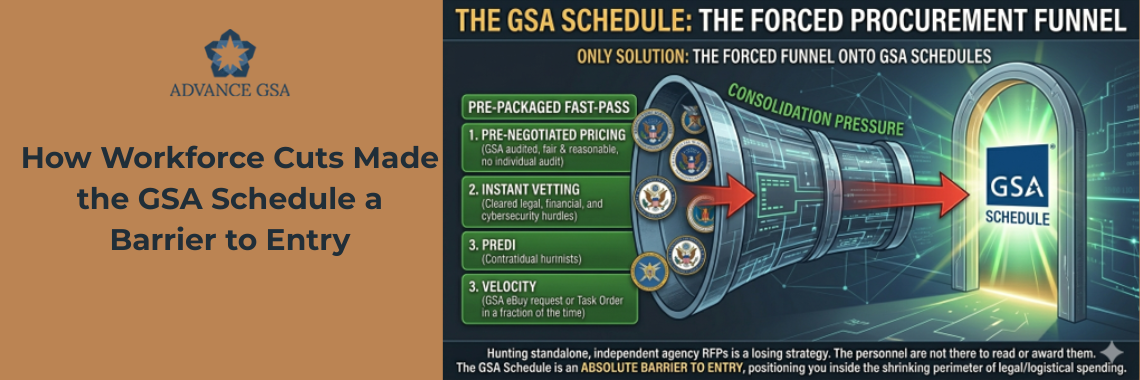
Because agencies are under intense pressure to drop spending while facing a severe deficit of contracting officers, the procurement pipeline is experiencing a forced funneling effect.
The GSA Schedule acts as a pre-packaged "fast-pass" for three major reasons:
|
GSA Year |
Total Small Business Sales |
Total Small Business Firms |
Average GSA Sales per Small Business |
|
2025 |
$14B |
12,600 |
1.4MM |
|
2027 (est) |
$30B |
15,000 |
2.0MM |
|
2029 (proj) |
$50B |
20,000 |
2.5MM |
If a business wants to secure federal revenue in this current environment, trying to hunt for standalone, independent agency RFPs is a losing strategy. The personnel aren't there to read them or award them.
The GSA Schedule has shifted from being a convenient option to an absolute barrier to entry. If you are on the schedule, you are inside the rapidly shrinking perimeter of where the remaining federal buyers are legally allowed, and logistically forced, to spend money.