Securing a spot on the General Services Administration (GSA) Multiple Award Schedule (MAS) is a game-changer for commercial vendors. As the federal government's primary online marketplace, the MAS program processes tens of billions in public sector purchasing every year.
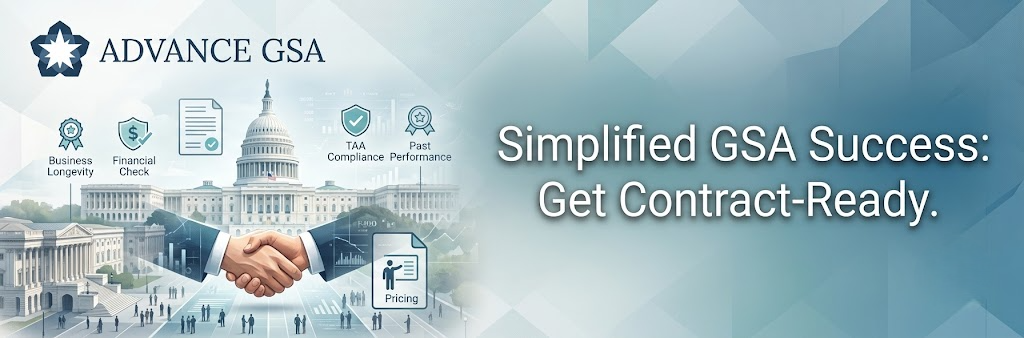
However, getting listed isn't a matter of filling out a quick application. GSA contracting officers thoroughly vet your corporate background, financial health, past client work, and pricing models. Navigating the full list of GSA Schedule requirements before starting your submission is the best way to prevent administrative delays and land a contract award.
Before evaluating your balance sheets or labor rates, GSA reviews whether your business meets basic operational standards.
Two Years of Commercial Operations: Standard rules require your firm to have a two-year operational track record. This proves to agency buyers that your company is stable and established. (If you operate an IT startup with less than two years in business, GSA’s Startup Springboard program lets you substitute executive experience or technical background to meet this requirement).
Active SAM.gov Registration: You must maintain an active profile on SAM.gov, complete with a Unique Entity Identifier (UEI) and appropriate North American Industry Classification System (NAICS) codes.
Commercial Sales History: You must show a proven track record of selling the specific products or services in your proposal to private sector, state, or local clients.
Addressing these baseline GSA Schedule requirements early keeps your submission from getting rejected during initial intake reviews.
Federal agencies are risk-averse. To protect public funds, GSA must confirm that your company will remain solvent throughout contract execution.
You will need to compile full balance sheets and profit-and-loss statements covering your two most recent fiscal years. If your statements show net losses or negative equity, you must provide a detailed narrative explaining how your company manages cash flow and maintains financial stability.
GSA requires past performance references for projects completed within the last two years. Contracting officers evaluate these references to grade your work quality, delivery speed, customer service, and overall reliability.
If your proposal includes physical goods or specialized technical solutions, regulatory compliance becomes a primary focus area.
Under the Trade Agreements Act (TAA), every end-product listed on a GSA Schedule must be manufactured or substantially transformed in the U.S. or a TAA-compliant country. Items manufactured in non-compliant countries (such as China or India) are strictly barred from schedule contracts. You must retain country-of-origin documentation for every item in your catalog.
Before submitting your electronic offer via the eOffer portal, designated company representatives must complete two mandatory courses on the GSA Vendor Support Center:
Pathways to Success Training
Readiness Assessment
Once complete, you will write clear technical narratives detailing your firm's operational capabilities:
Corporate Overview: A clear summary of your company’s organizational history, capabilities, and executive structure.
Quality Control Plan: An operational strategy demonstrating how you manage deliverable quality, handle customer issues, and maintain performance standards.
Special Item Number (SIN) Demonstrations: Detailed write-ups showing direct project experience for each individual service or product category (SIN) requested in your proposal.
Pricing reviews are often the most detail-intensive part of the proposal evaluation. GSA requires vendors to prove that their offered rates represent "fair and reasonable" value for federal buyers.
You will organize your rates inside a standardized Price Proposal Template (PPT). To justify those rates, you must attach commercial price lists, formal quote sheets, or paid client invoices showing that commercial customers regularly pay those prices.
Meeting these pricing GSA Schedule requirements depends on your contract model:
Commercial Sales Practices (CSP): You disclose your standard commercial discounting practices and identify your "Most Favored Customer" (MFC) to establish equal or better federal pricing.
Transactional Data Reporting (TDR): Available for designated SINs, TDR simplifies commercial pricing disclosures in exchange for reporting detailed monthly sales data post-award.
Earning your GSA Schedule contract is a major milestone, but maintaining it requires ongoing contract administration. GSA MAS contracts feature a 5-year base period with three 5-year extension options, covering up to 20 years.
To maintain an active contract, you must meet continuous GSA Schedule requirements:
Minimum Sales Threshold: Your contract must generate at least $100,000 in federal sales within the first five years, and $25,000 annually during extension options.
Industrial Funding Fee (IFF): You must report GSA sales quarterly (or monthly for TDR contracts) and remit the 0.75% IFF payment.
Catalog Management: Awarded price lists must be uploaded to GSA Advantage! within 30 days of award and updated whenever contract modifications occur.
Landing a GSA Schedule contract takes careful documentation and operational preparation. From verifying SAM.gov records and organizing two years of financial statements to demonstrating TAA compliance and establishing fair market pricing, every detail counts.
By reviewing all GSA Schedule requirements step by step, you can assemble a complete proposal, shorten evaluation timelines, and unlock long-term revenue opportunities across the federal marketplace.